
IT
08-10-2026
AI Limitations and Errors
Why does AI make mistakes?
Assistants such as ChatGPT, Copilot, Gemini, or Claude do not “search” for the correct answer in a database. They generate the most likely text, word by word, based on what they learned during their training. This almost always produces useful and correct answers, but there is no guarantee of truth behind them.
That is why an incorrect answer can look just as polished, confident, and convincing as a correct one. AI does not warn you when it is making something up.
The most common errors
1. Hallucinations: it invents data that sounds real
This is the best-known error. AI can invent a resolution that does not exist, a law article with the wrong number, a bibliographic citation, or a statistical figure, and present it completely naturally.
2. Outdated information
Each model is trained up to a specific date. If it does not have access to the internet, it may not be aware of recent changes in regulations, tax rates, deadlines, or ARCA procedures.
3. Calculation errors
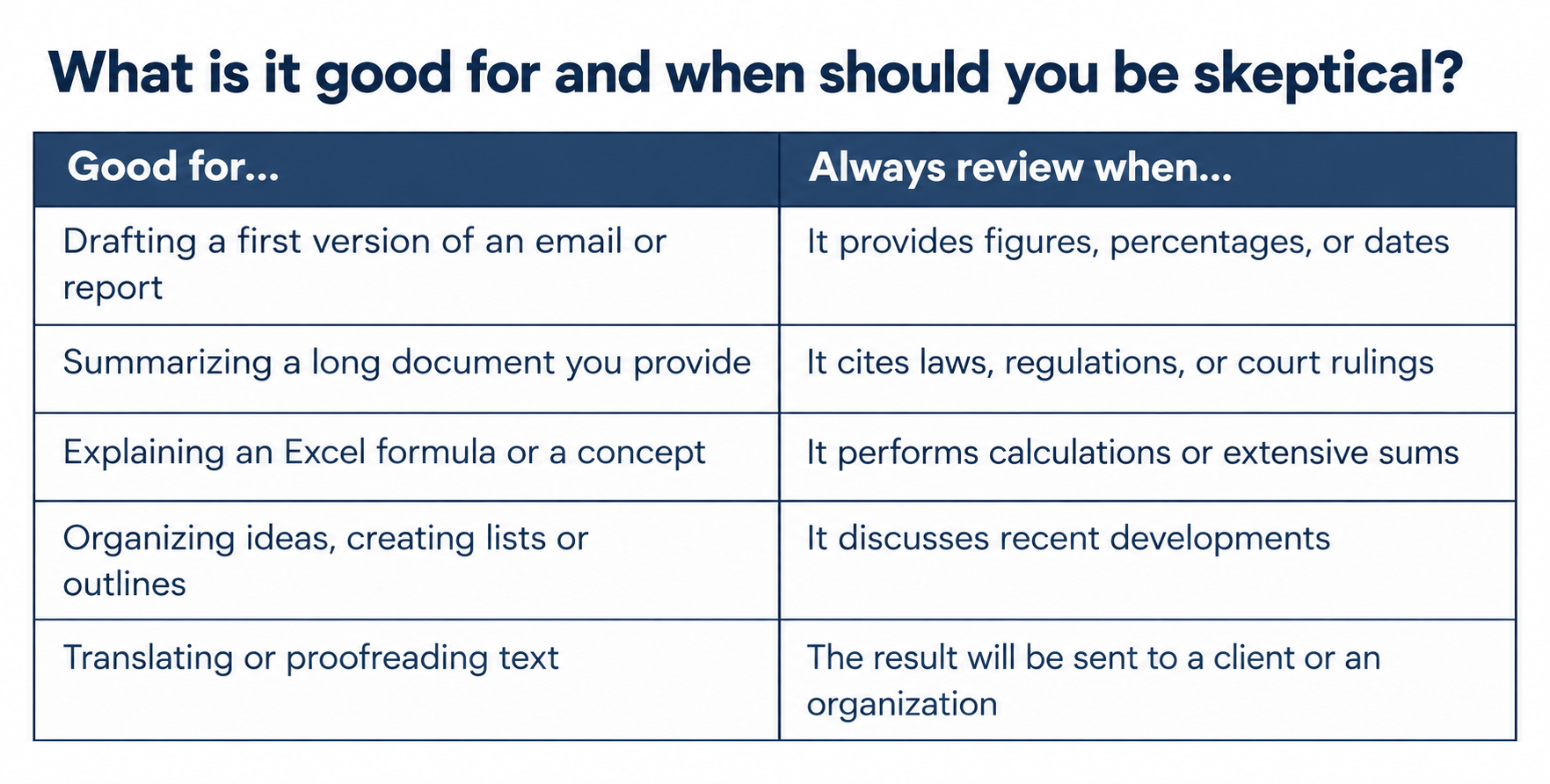
Although it may seem contradictory, language models are not calculators. They can make mistakes in long additions, chained percentages, or conversions. For numbers, Excel remains the reliable tool.
4. Agreeableness: it tells you what you want to hear
If the question contains an assumption (“this is exempt, right?”), AI tends to confirm it. It is advisable to ask in a neutral way and explicitly ask it to point out any errors.
5. Lack of context
AI does not know the client, the history of the case, or the firm’s internal criteria. It responds in general terms, and general information does not always apply to the specific case.
6. Biases
It learns from texts written by people, including their biases and imbalances. As a result, it may reproduce them in its writing, assessments, or recommendations.
Real cases
• Lawyers sanctioned (U.S., 2023). In the Mata v. Avianca case, a law firm filed a document containing judicial decisions invented by ChatGPT. The judge sanctioned them: no one had verified that the precedents actually existed.
• Air Canada chatbot (2024). The airline’s chatbot informed a customer of a refund policy that did not exist. A court ordered the company to comply with what its chatbot had said.
• Consulting firm’s report (Australia, 2025). A report submitted to a public agency included nonexistent references and citations generated with AI. The firm had to correct it and refund part of the fees.
The lesson is the same in all three cases: responsibility remains with the person who signs or submits the work, not with the tool.
Watch out for confidentiality!
Another important limitation is not related to AI but to us: what we write in an AI tool may be stored outside the company.
• Do not upload client data (CUIT, financial statements, salaries, contracts) to free or personal tools.
• Use only the tools authorized by the company.
If in doubt, checkt with your IT department before uploading a company file to any AI model.
Tip of the month
Ask AI to show you where each piece of data comes from: “indicate the source of each statement and flag anything you cannot confirm.” It does not make it infallible, but it makes it much easier to identify what needs to be verified.
In summary
AI is an excellent assistant, but not a source of truth. Use it to save time when preparing drafts, summaries, and explanations, and always keep human review in place, especially for anything involving figures, regulations, or information that will be shared with a client.
If you have any questions regarding this topic, please do not hesitate to contact me by phone at: 11 2759 1175 or by email at luismatas@jebsen.com.ar


Luis Matas
IT
October 2026
IT
This newsletter has been prepared by Jebsen & Co. for the information of clients and friends. Although it has been prepared with the greatest care and professional zeal, Jebsen & Co. does not assume responsibility for any inaccuracies that this bulletin may present.